A crochet toy is judged by its face. The body can be perfect and the toy still looks wrong, because the eyes are one round too high, or too close together, or the mouth is a straight line where it wanted a curve. Placement matters more than technique: a simple face in the right place reads better than elaborate embroidery in the wrong one.
This guide covers where to put the features, how to work them so they do not shift in the wash, and what to do differently for a toy that will go to a baby.
Embroider before you close the head
A face is much easier to place on an open head than on a finished ball. Work the head, stuff it lightly through the opening, and embroider while you can still reach inside with two fingers. The opening lets you anchor the ends of the yarn inside the head, where they will be hidden by the final stuffing and cannot be pulled out from the front.
If the head is already closed, you can still embroider it – but you will be anchoring the ends under the existing stitches on the surface, and the face will be slightly more vulnerable to a determined two-year-old.
Where the features go
Treat the head as a grid of rounds and stitches. Count the rounds from the top of the head and the stitches across the front, and write the positions down before you put the needle in. Three rules cover most toys:
- The eye line sits just above the middle of the face. On a head of 20 rounds, the eyes go on rounds 10 to 12, counted from the top. Higher than that and the toy looks startled; lower and it looks sleepy.
- Space the eyes one eye-width apart. If each eye is 3 stitches wide, leave 3 stitches between them. Closer reads as a mouse; wider reads as a frog.
- Put the nose and mouth on the centre line, one to two rounds below the eyes. A muzzle, if the toy has one, is the anchor: work the nose at its top edge and the mouth in the middle of it.
Mark the four points with pins before you thread a needle: left eye, right eye, nose, mouth. Look at the toy from the front and from above. Symmetry is easy to see with pins and almost impossible to see while you are sewing.
Safety eyes or embroidery
Plastic safety eyes are quick and give a clean look, but they are only safe when they are properly secured and only for a toy that will not go to a child under three. A safety eye is a plastic dome with a washer that grips a ridged post; pushed through the crochet and locked, it cannot be pulled out from the front. It can still be levered off by a determined child, which is why toys for babies should have embroidered eyes or eyes with the washer reinforced inside.
For a toy for a baby or a toddler, embroider the eyes. It is the only version that cannot come loose. If you want the glossy look, use a lock-washer eye, add a circle of felt behind it inside the head, and stitch the felt to the fabric around the eye – but embroidery is still the safer choice, and it is what the toy industry does for anything labelled 0+.
Tools and thread
Use a tapestry needle with a blunt tip and a large eye, and embroidery floss or a smooth cotton yarn that matches the weight of the crochet. Split the yarn if it is a 4-ply: two strands give a finer line than four. For a face on a 3 mm hook toy, two strands of DK cotton is about right; on a 5 mm hook toy, use the full yarn.
Starting and ending without knots
Knots work loose and leave a hard lump inside a stuffed toy. Start instead with a 20 cm tail, push the needle in through the opening and out at the first stitch position, and hold the tail inside with a finger while you work the first three stitches over it. At the end, run the needle back through the head and out at a different point, then weave the end through four or five stitches inside and cut it flush. The end is now buried in the stuffing, not on the surface.
Working each feature
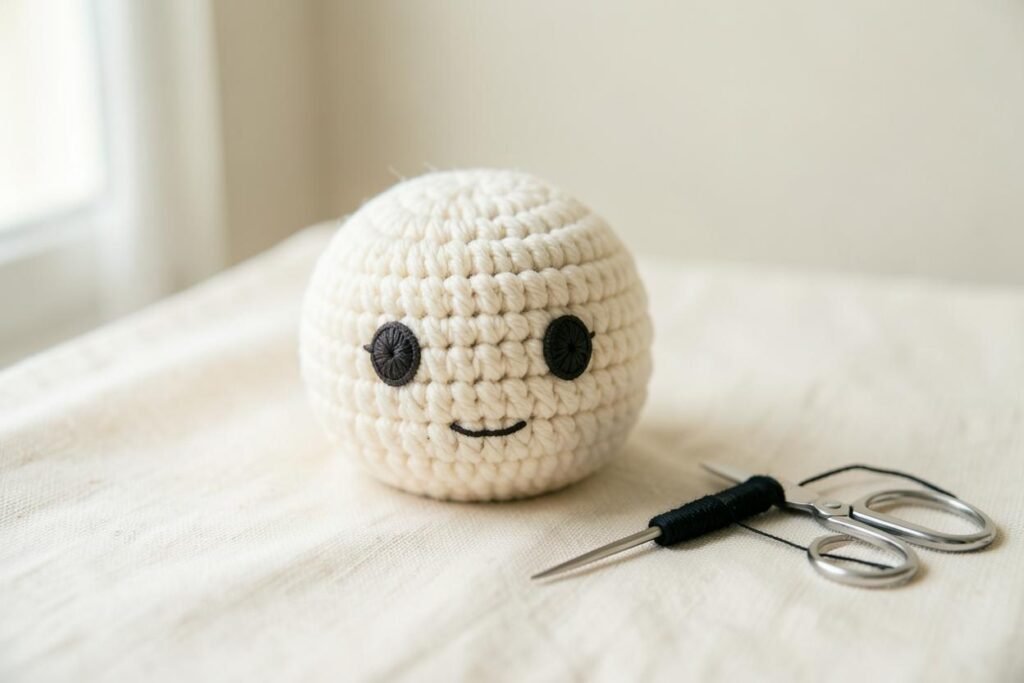
Eyes, simple version. Two or three straight stitches worked side by side, each 2 stitches wide, close enough to touch. Then one straight stitch over them at a right angle to make a small cross – the glint. This reads as an eye at any distance and takes a minute.
Eyes, satin version. Work a straight stitch outline first, then fill across it with parallel stitches, keeping the tension even so the surface stays rounded rather than flat. Satin stitch eyes are the shape of a small oval, wider than they are tall.
Eyelashes. One stitch angled out from the outer corner, worked after the eye is finished and anchored under the last stitch of the eye.
Nose. A small triangle: one straight stitch across the top, then two stitches angled down to a point, then fill. On a muzzle, work the nose at the top edge of the muzzle and keep it narrow – a wide nose makes the toy look like a bear even when it is a cat.
Mouth. A curved line, not a straight one. Work back stitch along a curve you have marked with pins, or chain stitch for a softer line. For a smile, the curve starts under the nose, dips, and turns up at both ends; for a neutral expression, a shallow curve; for a sad one, the ends turn down. Two stitches on each side are enough.
Blush. Two or three rounds of a soft pink in a satin stitch, or a small circle in chain stitch, placed under the outer corner of each eye. Keep it faint: strong blush on a small toy looks like a rash.
Fixing a face that has gone wrong
Unpick the stitches with the tip of the needle, one at a time, and pull the yarn out from the inside rather than the surface. The holes left by the needle close after a wash or a rub with a damp finger. If the face has left a permanent mark – a dark yarn that has stained the pale head – cover it with a small felt patch stitched around the edge, or work a muzzle over it if the shape allows.
A five-point check before you finish
- Look at the toy from a metre away. If the expression reads at that distance, the placement is right.
- Look from above: are the eyes on the same round?
- Look from the side: do the eyes wrap round the curve of the head, or sit flat on the front? They should follow the curve.
- Tug each anchored end gently. Nothing should move.
- Turn the toy upside down and shake it. Nothing should rattle, and no end should work loose.