The yarn a pattern calls for is almost always the yarn the designer had, not the only yarn that works. Substituting is normal – discontinued lines, a colour you cannot get, a price you will not pay, an allergy in the house. What goes wrong is substituting by eye: the ball looks the same thickness, so it must be the same weight.
It is not. Two yarns of the same thickness can have different yardage, different fibre and different behaviour in the wash. This guide is the order to check things in, and the one test that settles the question.
1. Match the weight, not the look
Yarn weight is a range, not a number, and the ranges overlap. Look for the yardage per 100 g on the ball band, which is the most reliable guide to how thick the yarn actually is:
| Category | Approximate metres per 100 g | Typical hook |
|---|---|---|
| Lace / 1-ply | 600 and up | 2 – 2.5 mm |
| Fingering / 4-ply | 360 – 450 | 2.5 – 3.5 mm |
| Sport / 5-ply | 280 – 350 | 3.5 – 4 mm |
| DK / 8-ply | 200 – 260 | 3.5 – 4.5 mm |
| Worsted / aran | 150 – 200 | 4.5 – 5.5 mm |
| Bulky / chunky | 100 – 140 | 6 – 8 mm |
| Super bulky | under 100 | 9 mm and up |
Two DK yarns at 210 and 250 metres per 100 g are close enough to swap without changing hook. A DK at 210 and a worsted at 170 are not: the worsted will give a wider, heavier fabric on the same hook.
2. Do the yardage maths before you buy
Patterns state yarn in grams, which is useless if your substitute has a different yardage. Convert to metres first, then back to balls:
- Original: 400 g of a yarn with 220 m per 100 g = 880 metres total.
- Substitute: a yarn with 180 m per 100 g needs 880 / 180 x 100 = 489 g, so five 100 g balls.
- Add 10 per cent for joinings, swatching and a longer project in a denser stitch: buy 540 g.
Buy the extra ball. A dye lot that has sold out is the most common reason a nearly finished project stalls.
3. Ask what the fibre does
Fibre decides how the finished piece behaves, and for some projects that matters more than gauge:
- Wool is elastic and warm, holds shape after blocking, and felts if washed hot. Good for garments; poor for a toy that will be chewed.
- Cotton is strong, inelastic and heavy. It shows stitch definition, holds a bag’s shape, and grows under its own weight in a long garment.
- Acrylic is light, cheap and washable, does not block like wool, and can pill. The default for baby items and blankets.
- Chenille is soft and dense, hides stitch definition, sheds, and mats when washed. Excellent for plush toys, wrong for anything with a pattern.
- Alpaca and mohair are warm for their weight, drape heavily, and have little elasticity – a garment in them grows.
A swap that changes the fibre changes the object, even at the same gauge: a cotton cardigan and an acrylic one in the same stitch pattern are different garments.
4. Swatch, and measure the swatch twice
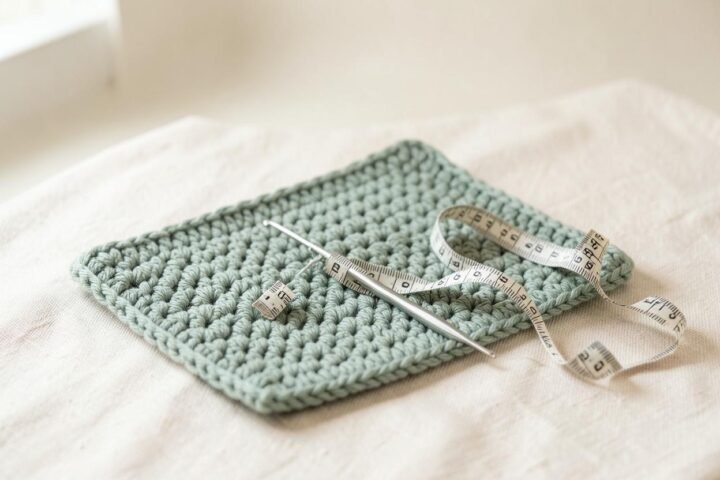
Work a swatch at least 15 cm square in the stitch pattern the project uses, not in single crochet if the project is in half double. Measure it before blocking and after: some yarns change by 10 per cent when wetted, which is a whole garment size.
Compare your stitch and row counts with the pattern. Rows matter less for many projects – you can work to a measurement – but stitch counts across matter always. If your swatch is 18 stitches per 10 cm where the pattern wants 20, your finished piece will be about 11 per cent wider.
5. If the gauge will not match, change the hook
Go up one hook size if you have too many stitches per 10 cm, down one if too few, and swatch again. Two hook sizes is usually the limit: past that, the fabric has changed character – too stiff at the small end, too open at the large – and the right answer is a different yarn.
Do not try to fix gauge by crocheting more tightly or loosely. Tension drifts back to normal the moment you stop thinking about it, and the piece changes halfway up.
6. Combining strands
Two strands of a finer yarn held together can replace a thicker one, which is useful when you have a lot of 4-ply and want a worsted fabric:
- Two strands of 4-ply (about 400 m per 100 g) behave roughly like a DK to worsted.
- Two strands of DK behave roughly like a bulky.
- Three strands of 4-ply behave roughly like a bulky.
Swatch anyway: two strands twist around each other and the combined yardage is half the single-strand figure, so 100 g of 4-ply held double gives you the metreage of 50 g.
7. Colour, dye lot and the last check
Buy all the yarn for a project at once, from the same dye lot, and check the ball bands match. Two dye lots of the same colour can differ enough to show as a stripe in a blanket. If you must mix lots, alternate balls every few rows so the difference reads as texture rather than as a line.
Last check before the first stitch: hold the substitute next to the original if you have any left, work ten stitches, and look at the fabric. If it is denser, looser, shinier or fuzzier than the swatch photo in the pattern, decide now whether that is acceptable – because it will be the whole project.