Yarn choice decides whether a toy looks handmade in a good way or a lumpy way, and it decides it before the first stitch. The stitch pattern is almost irrelevant next to the fibre: the same sphere in soft cotton and in chenille are two different objects.
Here is how to choose, and how to substitute when the yarn named in a pattern is not available.
The test that matters: can you see through it?
Work five rounds of single crochet in your candidate yarn with the hook you intend to use. Hold it up to a window. If light comes through in pinholes, the fabric will show white stuffing once the piece is filled. Go down a hook size, or change yarn.
This single check matters more than any fibre description on a label. Amigurumi is dense fabric; drape, softness and sheen are secondary.
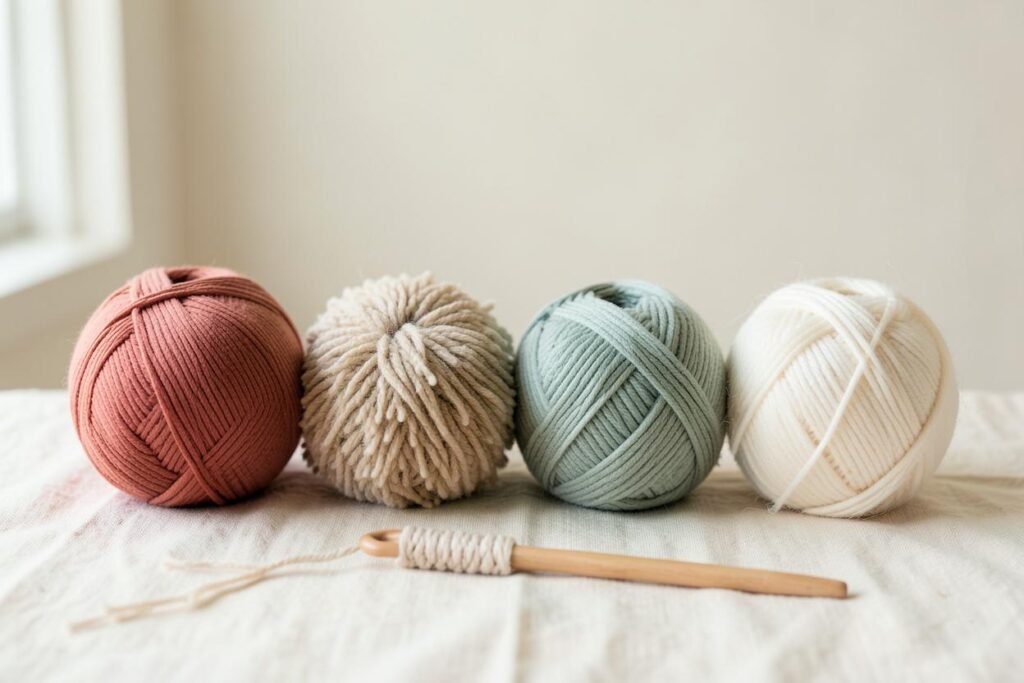
The four fibres you will actually meet
Cotton (DK or sport)
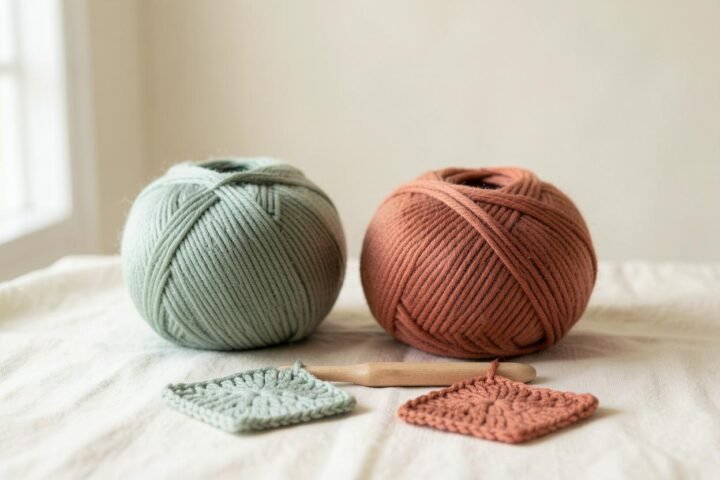
The default for amigurumi, and what most patterns on this site use. It holds stitch definition, does not bloom or fuzz, shows texture and colour changes cleanly, and washes well. It has no stretch, which is a benefit: limbs stay where you sew them. Soft cotton is easier on the hands than mercerised cotton, which is smoother and slightly shiny.
Chenille and blanket yarn
Thick, velvety, and fast. Makes large plush toys in a fraction of the stitches. Two drawbacks: the pile hides your stitch tops, so counting is genuinely harder, and the fabric is stretchy, so a firmly stuffed piece can sag. Use a hook one size down and count every round — the stitches are there, they are just buried.
Acrylic
Cheap, available everywhere, and perfectly workable. It fuzzes with use and can pill on a toy that is handled daily. It is also slightly stretchy. For a display piece it is fine; for a baby toy that will be washed weekly, cotton wears better.
Wool and wool blends
Warm, springy, and excellent for felted or textured pieces. Untreated wool felts in the wash, which will shrink and blur a toy. If the piece will be washed, use superwash wool or a blend, and test a swatch first.
Weight, hook and what to expect
| Yarn weight | Label hook | Hook for amigurumi | Typical finished scale |
|---|---|---|---|
| Fingering / 4-ply | 2.25–3 mm | 1.75–2 mm | Keyrings, 3–5 cm pieces |
| Sport / 5-ply | 3–3.5 mm | 2–2.25 mm | Small toys, 6–10 cm |
| DK / 8-ply | 4 mm | 2.25–2.5 mm | Standard toys, 10–20 cm |
| Worsted / aran | 5 mm | 3–3.5 mm | Large toys, 20–30 cm |
| Chunky | 6–8 mm | 4.5–5.5 mm | Floor cushions, giant plush |
The amigurumi hook is consistently one to two sizes below the label. That is not a preference; it is what produces fabric that holds stuffing.
How much yarn a toy takes
Patterns on this site give a gram figure for the main colour, measured from the finished piece rather than estimated. As a rough guide before you buy:
- 6–8 cm toy: 15–25 g total.
- 12–15 cm toy: 40–60 g.
- 20–25 cm toy: 80–120 g.
- 30 cm toy with clothing: 120–180 g, often in two or three colours.
Buy one ball more than you think you need. Dye lots differ, and a second ball bought later will not match the first.
Substituting without ruining the shape
Match two things: the yarn weight, and the behaviour of the fibre. Weight keeps the stitch count and finished size; behaviour keeps the fabric dense.
- Cotton to cotton, same weight: direct swap, no change.
- Cotton to acrylic, same weight: work a swatch first. Acrylic stretches; you may need to go down half a millimetre.
- DK to worsted: do not swap without resizing. The piece grows by roughly a third in each dimension, and the stuffing shows.
- Any yarn to chenille: expect the piece to be much larger and softer. Drop two hook sizes and check the window test.
Colour, and the one rule worth keeping
One neutral body, one or two accent colours, and a contrast for the face. Patterns that use five colours in the body tend to read as busy at toy scale, because the piece is small and the eye needs a clear silhouette. Use a darker shade than the body for the muzzle and paws, and keep the eye colour high-contrast — dark eyes on a light face, or the reverse.
Variegated yarn is tempting and mostly a mistake for faces: the colour shifts land unpredictably across the snout. It works well for bags and blankets, where the pattern is large enough to carry it.
What the pattern means by “about 80 g”
It means the finished piece weighed 80 g on a kitchen scale. It is a buying guide, not a constraint. If your toy weighs 95 g because you crocheted more tightly in a thicker cotton, the toy is the same size and nothing is wrong.
Next: gauge and hook size in amigurumi, or browse the toy patterns.