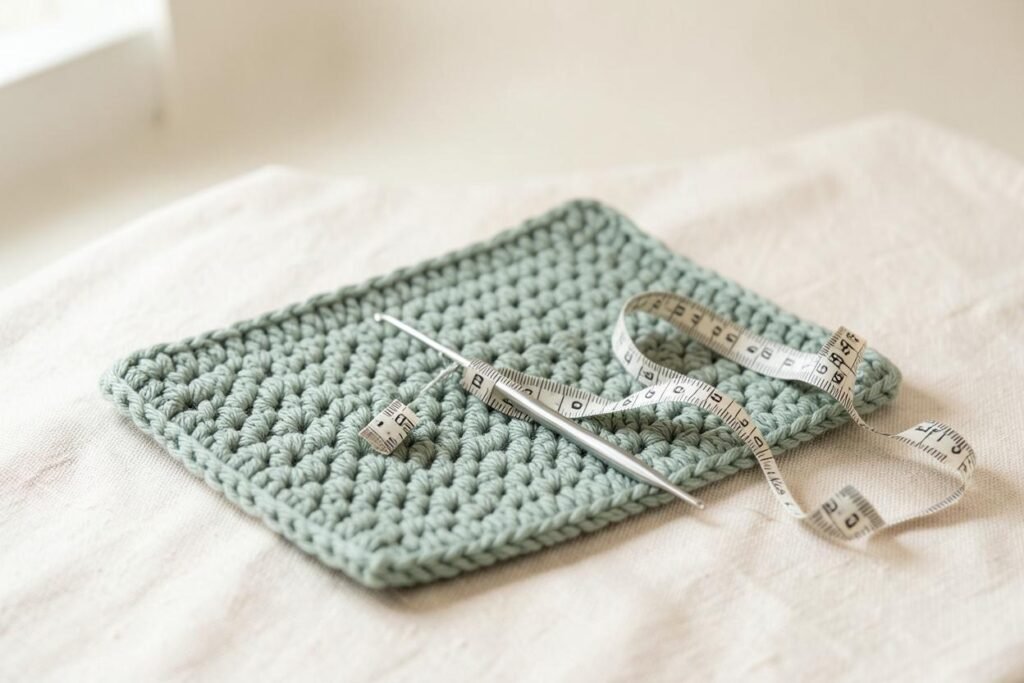
In garment crochet, gauge means matching the designer’s stitch count so the piece fits a body. In amigurumi, gauge means something different: making fabric dense enough that stuffing does not show, at a size close enough to the pattern that the proportions still work.
That difference is why amigurumi patterns rarely give a 10 cm swatch, and why “my toy came out wrong” is almost always a hook-size problem rather than a counting problem.
Why the fabric has to be dense
Single crochet worked at the label’s recommended hook produces a fabric with small holes between stitches. Flat, that is fine. Stuffed, the fill pushes against the inside and finds every hole. The result is a pale, fuzzy surface where white fibre shows through the colour.
Two sizes down from the label is the usual correction. DK cotton labelled for 4 mm is worked at 2.25–2.5 mm for a toy. If your hands are tight, one size down may be enough; if they are loose, two is not excessive.
Measuring without a swatch
You do not need to crochet a square before starting most toys. Use the piece itself:
- After round 4 or 5, lay the flat circle on a table and measure the diameter.
- Compare with the pattern. Most patterns state the finished size; work backwards from it. A 6 cm ball has a 6 cm diameter at its widest.
- Check the fabric with the window test. If light passes through, stop and go down a hook size before the piece is too large to rework.
Ripping back four rounds costs ten minutes. Discovering at the stuffing stage costs the whole toy.
The maths of size drift
A toy is a three-dimensional object, so a small change in stitch width compounds fast. If your stitches are 10% wider than the designer’s, the finished piece is about 10% wider and 10% taller — but its volume increases by roughly a third, so it needs a third more stuffing and looks noticeably different.
That is why a toy “the same pattern” can come out 20% smaller in a different yarn. It is not a mistake in the pattern. It is the interaction of hook, yarn and hand tension, and it is why the pattern’s finished size is a target rather than a guarantee.
When gauge actually matters
- Sets of pieces. If you are making the same toy twice, or two limbs that must match, swatch or at least measure the first piece and match it.
- Multi-colour work. Changing colour every round tightens the fabric slightly; the effect is small but consistent.
- Chenille and textured yarns. The pile hides stitch tops and the fibre stretches. Measure the flat circle early.
- Clothing on a toy. A cardigan worked for a 30 cm toy will not fit a 33 cm one. Here gauge behaves like garment gauge.
Adjusting a pattern without rewriting it
You do not need to recalculate every round. Three moves cover most situations:
- Piece slightly small: go up one hook size for the body only. Do not change hook mid-piece.
- Piece slightly large: go down one hook size, and use less stuffing. A softer fill compresses into a smaller shape.
- Piece the right size but the fabric is loose: keep the hook, change the yarn to a denser fibre — cotton instead of acrylic, or a tighter-spun cotton.
Signs your tension is off
Too loose: the piece feels floppy before stuffing, stitches lean, holes are visible when held to light, and the count drifts because the hook catches the strand below.
Too tight: the hook squeaks, your hand aches after ten minutes, the piece curls hard at the edges, and the finished toy is noticeably smaller than the stated size. Go up half a millimetre and check the window test again.
The right tension for amigurumi is firm enough to be slightly tiring and no more. If it hurts, the hook is too small for the yarn and your hand, and a slightly larger hook with a denser yarn is the better fix.
A two-minute check before you start
- Hook is one or two sizes below the yarn label.
- The first four rounds lie flat and measure close to the pattern’s stated diameter.
- Held to a window, the fabric shows no pinholes.
- The count matches the pattern at the end of every increase round.
If all four pass, the toy will be the size the pattern says, and the stuffing will stay inside. Next: choosing yarn, or fixing the mistakes that still happen.
1 comment