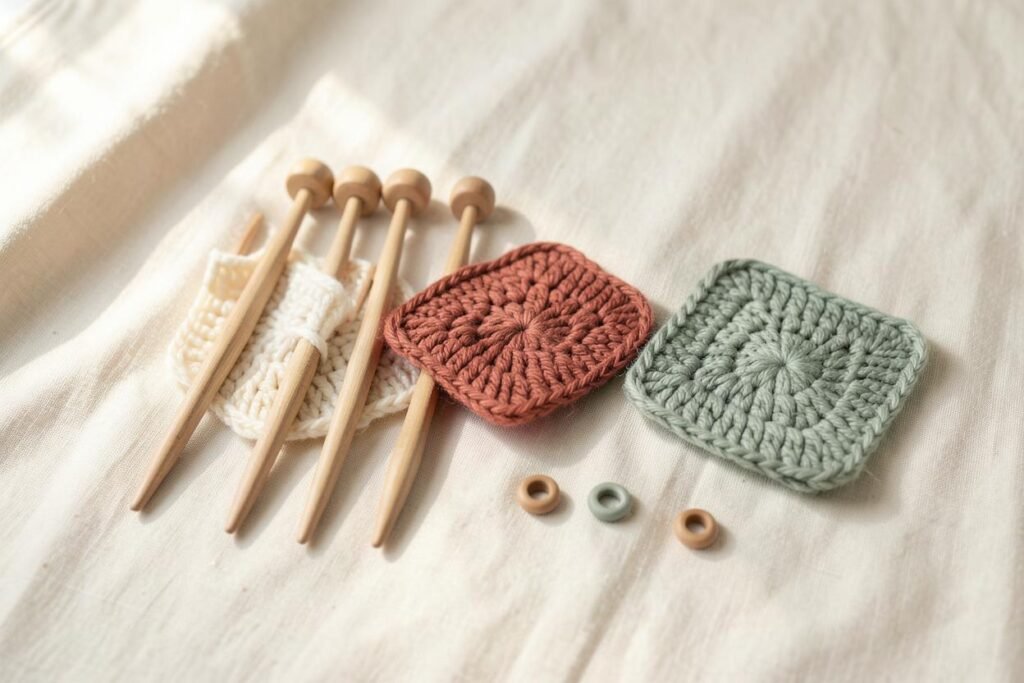
A crochet pattern is a compressed language. Once you know the words, a line like R7: (sc, inc) x 6 (18) tells you exactly what to do in eleven characters. Until you do, it looks like noise.
This page is the reference we use ourselves. It covers the standard abbreviations, the US-versus-UK trap that catches almost every beginner, and the small set of terms that pattern writers use without explaining. Bookmark it and keep it open while you work.
The US and UK terms are not the same words
Both countries call the same three stitches different things, and the difference is one step, not a translation quirk. A pattern written in UK terms and read as US terms produces a fabric roughly twice as tall as intended.
The rule is simple: the UK name for a stitch is one level up from the US name. What the US calls a single crochet, the UK calls a double crochet.
| What you actually work | US name | US abbreviation | UK name | UK abbreviation |
|---|---|---|---|---|
| A slip stitch | slip stitch | sl st | slip stitch | sl st |
| One loop on the hook, pull through | single crochet | sc | double crochet | dc |
| Yarn over first, then pull through | half double crochet | hdc | half treble | htr |
| Yarn over, pull through two loops twice | double crochet | dc | treble | tr |
| Two yarn-overs before the first pull | treble crochet | tr | double treble | dtr |
If a pattern does not say which system it uses, look at the first round of a flat piece. A round of 10 dc in US terms sits low and dense; 10 dc in UK terms stands tall with visible posts. Every pattern on this site is written in US terms and says so at the top of the abbreviations list.
Stitch abbreviations
| Abbreviation | Meaning | What it does |
|---|---|---|
| ch | chain | Foundation or a gap; adds no height on its own |
| sl st | slip stitch | Joins, travels sideways without height |
| sc | single crochet | The default amigurumi stitch |
| hdc | half double crochet | Slightly taller, softer fabric |
| dc | double crochet | Open, drapey fabric; bags and granny squares |
| tr | treble crochet | Tall stitches for shells and lace |
| ch-sp | chain space | The hole under a chain, not the chain itself |
| sk | skip | Leave a stitch unworked |
| st / sts | stitch / stitches | Counts the V on top of the fabric |
Shaping abbreviations
| Abbreviation | Meaning | Note |
|---|---|---|
| inc | increase | Two stitches into one stitch. In amigurumi, always sc unless stated |
| dec | decrease | Two stitches worked together into one |
| sc2tog | single crochet two together | The standard decrease; leaves a small step |
| invdec | invisible decrease | Worked in the front loops only; nearly invisible in amigurumi |
| sc3tog | three together | Used to close a limb or a sphere |
| flo | front loop only | Leaves a ridge; used for brims and colour changes |
| blo | back loop only | The same ridge, facing the other way |
| tfl | through front loop | Same as flo; varies by writer |
Rounds, rows and starting methods
- MR — magic ring. An adjustable loop you crochet into, then pull closed. No hole in the middle.
- ch ring — a chain joined into a circle with a slip stitch. Older patterns use this; it leaves a small hole.
- R or rnd — round (worked in a circle), as opposed to row (worked back and forth).
- spiral — you do not join or turn. The round marker moves; the fabric has no seam.
- join — finish the round with a slip stitch into the first stitch, then chain up.
- tch — turning chain. The chain (or chains) that give height at the start of a row.
Small terms that are never explained
- yo — yarn over. Wrap the working yarn over the hook.
- rep — repeat.
- * — the start of a repeated section. “rep from * to end” means go back to the asterisk.
- [ ] — a group worked into the same stitch or space, or a repeat, depending on the writer. The surrounding sentence tells you which.
- ( ) — at the end of a line, the stitch count for that round. Inside a line, a group to be repeated.
- 3 sc in next st — three separate single crochets, all into one stitch. Compare sc 3, which is three stitches, one each.
- 2 sc in next st — an increase, written out longhand.
Hook sizes, US to metric
US letter sizes are approximate; the millimetre number is the one that matters. When a pattern gives a letter and a number that disagree, trust the number.
| US | Metric | Typical use |
|---|---|---|
| B/1 | 2.25 mm | Fine cotton, small amigurumi |
| C/2 | 2.75 mm | DK cotton toys |
| D/3 | 3.25 mm | DK and light worsted |
| E/4 | 3.5 mm | Worsted toys |
| G/6 | 4.0 mm | Worsted blankets, bags |
| H/8 | 5.0 mm | Chunky, chenille |
| J/10 | 6.0 mm | Super chunky, fast blankets |
How to use this page
Read the abbreviations list at the top of any pattern before the first round, even if you think you know it. Writers differ on dec (some mean invisible, some mean sc2tog) and on whether ch 1 at the start of a round counts as a stitch. A pattern that defines its terms is doing you a favour; one that does not is worth a second look before you spend yarn on it.
If you are new to reading patterns at all, start with How to Read a Crochet Pattern, Line by Line. If you are ready to work your first toy, go to Your First Amigurumi.
1 comment